
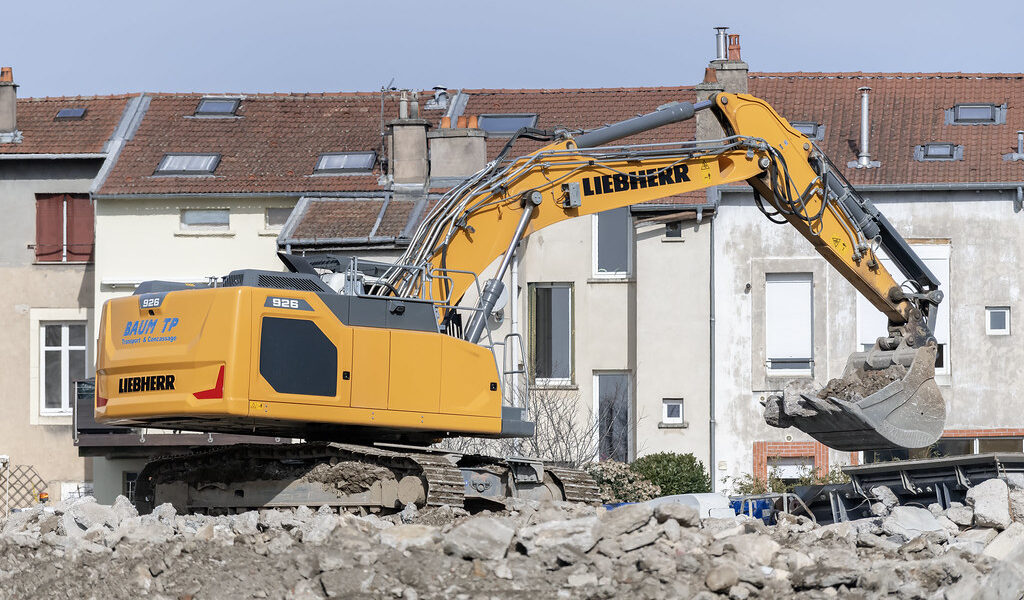
Liebherr excavators are built for long service life, but rubber isolation components set the pace for that life. When engine mounts degrade or cab isolation fails, vibration transmits directly into the structure, accelerating fatigue in hydraulic lines, sensors, and the operator’s spine. This guide covers the critical rubber parts across the Liebherr R 906 through R 956 range and the LR series crawler cranes, with practical intervals and sourcing guidance for fleet managers and maintenance engineers.
Engine Mount Systems: 8-10 Point Configurations on Large R Series
Liebherr’s larger crawler excavators — the R 920, R 926, R 936, R 945, and R 956 — use 8 to 10 point engine mount arrays. This is not incidental. The proprietary Liebherr diesel engines fitted to these machines from Tier 3 onward generate significant low-frequency torque pulses, and Liebherr engineers compensated by distributing isolation across more mount points than competitors typically use.
The R 906 and R 914, being in the 9–14-tonne class, run a more conventional 4-6 point system. These are simpler to service and parts availability is generally strong. The R 920 sits at a transition point: Liebherr fitments from this class upward increasingly favour stiffer durometer mounts to manage the torque characteristics of the larger displacement engines.
Key specifications to verify before ordering:
- Shore hardness (typically 45–60 Shore A for primary mounts on mid-range models; stiffer on larger machines)
- Bolt pattern and stud thread specification (Liebherr uses metric M12 through M20 depending on mount position)
- Load-bearing direction — Liebherr mounts are direction-sensitive, particularly on the R 936 and above
- Bonded vs. non-bonded bracket style
Do not assume interchangeability between the R 926 and R 936 even though the machines share visual similarity. The R 936’s engine mount specification changed with the Tier 4 Final emissions transition, and fitting R 926-era mounts to a Tier 4 Final R 936 will result in premature failure within 500–700 hours.
Tier 4 Final Transition: What Changed for Mount Specs
Unlike Caterpillar or Komatsu, which source Tier 4 engines from external suppliers in some configurations, Liebherr develops and manufactures its own diesel engines in-house. The D936 and D946 series engines powering the larger R series excavators were redesigned for Tier 4 Final compliance with revised injection pressure, EGR routing, and SCR aftertreatment. These changes shifted the engine’s vibration signature.
The practical result: mount stiffness specifications changed at the Tier 4 Final boundary for R 926, R 936, and R 945. Machines produced before and after this regulatory boundary — roughly 2013–2016 depending on market — require different mount sets. Always confirm engine serial number and emissions tier before ordering.
Cab Isolation: The Liebherr Comfort Cab System
Liebherr’s Comfort cab uses a multi-point rubber isolation system that decouples the ROPS cab structure from the upper carriage. On the R 936 and larger models, this system typically uses four primary isolation mounts positioned at the cab corners plus secondary buffer stops that limit travel under extreme shock loads.
Cab mount degradation is one of the most underreported maintenance issues in Liebherr fleets. Operators often adapt to increasing vibration gradually, and by the time the problem is formally reported, the mounts are typically past 50% compression set — meaning they are no longer functioning as isolators but as rigid transfer points.
Replacement interval guidance:
- Standard construction applications: 3,000–4,000 hours or 3 years (whichever first)
- Quarry and hard rock applications: 2,000–2,500 hours
- Demolition applications: 1,500–2,000 hours
Cab mount condition can be assessed visually by checking for rubber extrusion past the metal bonding plates, cracking at the bond interface, or visible compression set (the rubber appears flattened rather than rounded in cross-section). Do not wait for complete bond failure — by that point, the cab has been transmitting unfiltered structure-borne vibration for hundreds of hours.
Mini-Story: Quarry Fleet in Northern Spain
A fleet manager operating six Liebherr R 936 units at a granite quarry near Burgos noticed that two machines were consistently generating more operator complaints about cab vibration than the rest of the fleet. Maintenance logs showed the two machines had been running the same cab mounts since commissioning — approximately 3,800 hours, well past the recommended interval for quarry conditions.
Inspection confirmed significant compression set and minor delamination at the rear corner mounts. After replacing all four cab mounts on both machines, operator-reported vibration complaints dropped immediately. More importantly, a follow-up inspection of the hydraulic hose routing showed two hose clamp failures on both machines that were directly attributable to vibration-induced fatigue — failures that could have resulted in hydraulic fluid ejection near the hot engine bay.
Hydraulic Pump Drive Couplings
The main hydraulic pump on Liebherr R series excavators is driven directly from the engine flywheel via a flexible rubber disc coupling. This coupling absorbs torsional shock during load changes — particularly during combined swing and crowd operations, which are common in trenching and loading cycles.
On the R 914 through R 926, the coupling is a single-element design. On R 936 and above, Liebherr fits a compound coupling with multiple rubber segments in a spider or disc configuration. The compound design provides higher torque capacity and more progressive damping.
Service life varies significantly by application:
| Application | Typical Coupling Interval |
|---|---|
| General earthmoving | 4,000–5,000 hours |
| Trenching (high load cycles) | 2,500–3,500 hours |
| Rock breaking with hammer attachment | 1,500–2,500 hours |
| Demolition | 2,000–3,000 hours |
Hydraulic hammer use is the single biggest accelerator of pump coupling wear. The impulsive loads from breaker operation transmit through the hydraulic circuit back to the pump, and from the pump through the coupling to the engine. Fleets running Liebherr excavators with hydraulic hammers should inspect coupling condition at every 1,000-hour service interval.
Failure signatures: Audible clunk during engagement, increased hydraulic pump noise at idle, visible rubber fragmentation in the bell housing area.
LR Series Crawler Cranes: Different Demands, Same Attention to Rubber
The Liebherr LR 1130, LR 1200, LR 1300, and larger crawler cranes use rubber isolation in different configurations than excavators, but with equally demanding requirements. The primary rubber components on LR series cranes include:
Slewing ring isolation elements: Rubber buffers and pads that isolate the superstructure slewing mechanism from the carrier. These are critical for preventing fretting wear on the slewing ring gear teeth.
Travel drive motor isolation: Crawler crane travel drives are typically hydraulic motors with rubber-isolated mounting to the crawler frame. In long-distance crane travel over rough terrain, these mounts absorb significant impact loading.
Engine mount systems on carrier: LR series cranes use conventional 4-6 point engine mount systems in the carrier structure. The engines are typically sourced from major suppliers (Mercedes, Cummins depending on model and market) and mount specifications follow the engine OEM’s standard isolation requirements.
Counterweight buffer pads: Large LR cranes use removable counterweight sections. The contact surfaces between counterweight sections and the car body use rubber buffer elements that prevent metal-to-metal impact during crane travel and minor configuration changes.
Mini-Story: LR 1300 Working an Offshore Wind Farm Installation
A crane contractor in the Netherlands operating an LR 1300 during a three-year offshore wind turbine foundation project found that travel drive motor mounts were wearing at nearly twice the expected rate. Investigation identified the cause: the machine was regularly traveling over compacted gravel hardstanding with sharp aggregate, creating higher-frequency shock inputs than typical earthen travel surfaces.
The contractor switched to a slightly higher-durometer mount specification for the travel drive positions — moving from 50 Shore A to 60 Shore A — while retaining the standard specification for the superstructure positions where compliance was more important than stiffness. Travel drive mount replacement intervals extended from 1,800 hours to approximately 2,700 hours after the change.
LiDAS Telematics and Maintenance Planning
Liebherr’s LiDAS telematics system provides real-time operating hours, location, fault code logging, and can be configured to generate maintenance alerts. For rubber component planning, LiDAS is most useful for tracking actual operating hours precisely and identifying machines with high attachment use cycles.
Maintenance teams using LiDAS can set component-specific hour counters for engine mounts, cab mounts, and pump couplings separately from the machine’s total hour meter. This is particularly valuable for machines that have had rubber components replaced at different intervals — a common situation in fleets where some machines worked harder early in their life and required earlier first replacements.
LiDAS does not directly measure rubber component condition, but it provides the data infrastructure to implement a consistent, hours-based replacement program rather than reactive maintenance.
Sourcing Rubber Parts for Liebherr Excavators
Liebherr operates its own global parts network, and OEM parts are available through authorized dealers. However, lead times from dealer stock — particularly for less common mount positions on older machines or large R series models — can extend to several weeks when parts must be ordered from the Liebherr distribution center.
For fleet operators running multiple Liebherr machines across distributed sites, maintaining a consignment stock of the highest-turnover rubber items (cab mounts, pump coupling elements) makes operational sense. Specialist rubber component manufacturers with documented dimensional equivalence and material certification can supply these items with shorter lead times and at a price point that supports forward stocking.
When evaluating non-OEM rubber parts for Liebherr applications, request the following from any supplier:
- Shore hardness certification (not just stated specification — laboratory confirmation)
- Compression set test results (ISO 815 or equivalent)
- Bonding peel strength for metal-rubber bonded components
- Temperature range rating (Liebherr engine bay temperatures can exceed 100°C ambient near certain mount positions)
Planning Your Rubber Parts Inventory for a Liebherr Fleet
For a fleet of five Liebherr R 936 machines in a mixed construction/quarry application, a practical forward stock would include:
- 8-10 engine mount units per machine (one complete set forward stock per two machines)
- 4 cab mount units per machine (full set forward stock per machine for quarry operations)
- 2 hydraulic pump coupling element sets per machine per year (higher if hammer use is significant)
- 4-6 miscellaneous buffer and stop mounts per machine
This stocking level avoids unplanned downtime from rubber component failure while keeping working capital committed to inventory at a manageable level.
Request a parts quotation for your Liebherr fleet with specific model and serial number details.
Mini-Story: Fleet Standardization at a German Road Builder
A German civil contractor operating four Liebherr R 920 units and two R 936 units decided to standardize their rubber parts program after two unplanned stoppages in a single quarter caused by engine mount failures on machines that were overdue for replacement.
Working with their parts supplier, they established a 2,500-hour inspection and 4,000-hour replacement program for all rubber isolation components, with LiDAS hour data feeding a simple spreadsheet that flagged approaching service windows 200 hours in advance. In the 18 months following implementation, they recorded zero unplanned stoppages from rubber component failure and reduced their average rubber parts cost per machine-hour by approximately 12% by eliminating the emergency premium pricing associated with urgent supply requests.
Key Takeaways
- Liebherr R series excavators from R 920 upward use 8-10 point engine mount arrays; specifications are model-specific and changed at the Tier 4 Final emissions boundary — confirm engine tier before ordering.
- Cab isolation mounts on the Liebherr Comfort cab system should be replaced at 2,000–2,500 hours in quarry and demolition applications, not at the standard 3,000–4,000 hour interval.
- Hydraulic pump drive couplings wear significantly faster on machines running hydraulic hammer attachments; inspect at every 1,000-hour service interval rather than waiting for audible failure symptoms.
- LR series crawler cranes require rubber parts attention in four distinct systems: slewing ring isolation, travel drive motor mounts, engine mounts on the carrier, and counterweight buffer pads.
- LiDAS telematics provides reliable operating hour data for component-level maintenance planning; use it to set individual replacement counters for each rubber component type rather than tracking against total machine hours only.
Word Count: ~1,650 words