
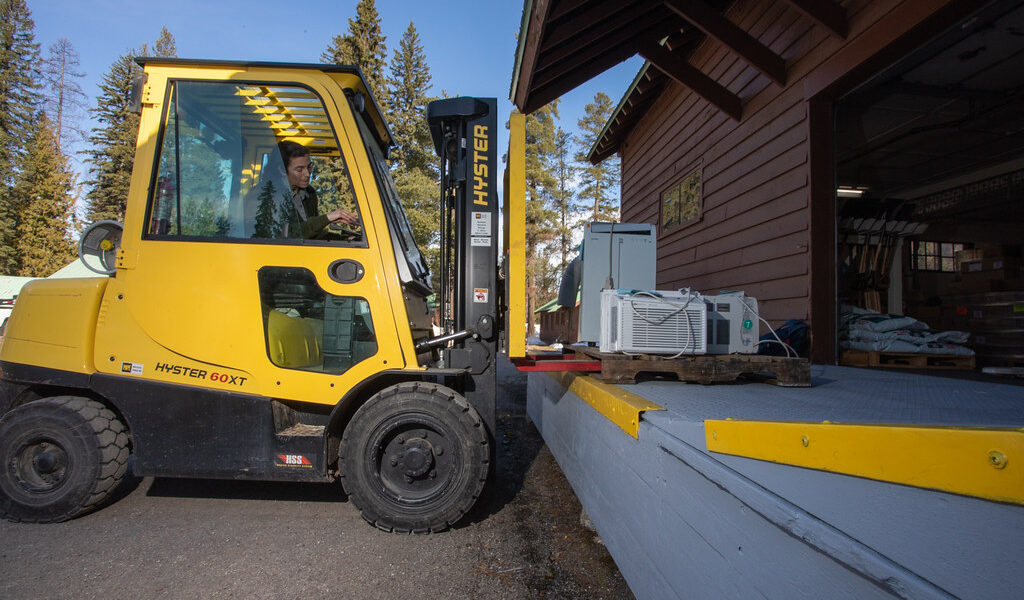
Warehouse operators in high-cycle distribution center environments report that forklift rubber component failures cause more unplanned downtime than tire failures — yet forklift rubber maintenance appears on almost no planned maintenance schedule in the industry. Tires get inspected. Forks get certified. Hydraulic fluid gets changed on a calendar interval. The rubber mounts, bushings, and isolation elements that hold the machine together and protect the operator receive no scheduled attention until something fails loudly enough to stop operations.
This guide is written for maintenance engineers, fleet managers, and operations supervisors who want to change that. Understanding which rubber components forklifts actually use, what each one does, and when each one fails gives you the data to build a planned maintenance program that prevents downtime rather than responding to it.
The payoff is real. In high-cycle warehouse operations running multiple shifts, a single unexpected forklift downtime event costs $400 to $800 in lost productivity per hour when racking system throughput is constrained. Most forklift rubber component replacements cost $50 to $300 per part. The economics of prevention are not complicated.
Browse Babacan Group’s forklift rubber component range or request a quote for your specific fleet — our team responds within one business day.
Forklift Types and Their Rubber Component Profiles
Forklifts are not a single machine category. The rubber component requirements vary significantly across the main types, and maintenance programs must be built against the specific machine type in operation.
Counterbalance Forklifts (IC Engine)
The counterbalance internal combustion forklift is the most common type globally. Manufacturers in this segment include Toyota (8-series), Linde (H series), Crown (C5), Hyster (H series), and Jungheinrich (DFG/TFG). These machines operate on LPG, diesel, or CNG and typically cover 2.5 to 7 tonne capacity.
The rubber component profile for IC counterbalance forklifts is the most complex in the category: engine mounts, mast pivot bushings, overhead guard isolation mounts, drive axle housing mounts, and in some configurations, exhaust system flexible joints. Each component type has a different service life and a different failure consequence.
Counterbalance Forklifts (Electric)
Electric counterbalance forklifts — Toyota 8FB, Linde E series, Crown FC5, Hyster J series — have the same mast pivot bushing and overhead guard isolation requirements as IC machines, but no engine mounts. The primary rubber wear items shift to drive motor mounts and battery tray isolation elements.
Battery tray isolation is often overlooked. A battery pack on a 3-tonne electric counterbalance forklift weighs 800 to 1,200 kg. The isolation elements between the battery tray and the chassis frame damp vibration transmitted from the drivetrain and floor surface. Degraded isolation elements allow battery movement that stresses cable connections and battery terminal hardware.
Reach Trucks
Reach trucks — Linde R series, Toyota 7SRHF, Crown ESR — are electric-only machines designed for narrow aisle operation in high-bay racking environments. They have no engine mounts. The critical rubber component is the mast pivot bushing, which sees exceptionally high cycle rates in distribution center operations. A reach truck in a busy automated distribution center may complete 400 to 600 reach cycles per shift at rack heights up to 12 meters. Mast pivot bushing condition at those heights is a safety issue — mast wobble at 10 meters is a different problem than mast wobble at 3 meters.
Very Narrow Aisle (VNA) Trucks
VNA trucks operate in aisles 1.5 to 1.8 meters wide with the operator and load platform both rotating within the aisle. Rubber components are minimal — primarily mast pivot elements and guidance system interface pads. These are low-rubber-content machines from a maintenance standpoint.
Engine Mounts: IC Counterbalance Forklifts
Engine mounts on IC counterbalance forklifts are a 4-point system in most designs. The engine is relatively compact compared to construction machinery applications, and the mounts are typically cylindrical sandwich-type units — a rubber cylinder bonded between inner and outer metal sleeves.
The engine platform varies by OEM and market. Toyota’s 8-series uses their own gasoline and LPG engines (1FS, 2Z, 1FZ series). Linde’s IC H series uses Volkswagen industrial LPG and diesel engines across much of the European market. Hyster uses Mazda LPG engines on many North American models. This matters for parts sourcing: a Linde forklift may accept a different mount specification than a Toyota with nominally similar engine displacement, because the engine physical dimensions differ.
Standard engine mount replacement interval is 3,000 operating hours under normal conditions. This interval shortens considerably in two specific environments: cold storage operation and dirty outdoor environments where the rubber is exposed to ozone-laden air and UV radiation.
Ozone attack on natural rubber compounds is well documented — the material experiences surface cracking that progressively deepens and eventually causes bond failure at the rubber-metal interface. Forklifts operating outdoors in sunny climates, or in environments with welding or plasma cutting (both strong ozone sources), may see mount service life reduced to 1,500 to 2,000 hours. Ozone-resistant EPDM compounds address this problem directly.
For a broader discussion of rubber compound selection principles, see our anti-vibration mount selection guide.
Mast Pivot Bushings: The High-Cycle Critical Component
The mast on a counterbalance forklift tilts forward and back via two hydraulic tilt cylinders. The mast pivots at mounting points on the front axle housing — typically two pivot points, each using a large-diameter rubber-lined bushing assembly. In most designs, this is a steel housing with a rubber-metal composite insert that allows mast rotation while damping shock.
The cycle rate for mast tilt bushings is determined by the operating environment. A forklift in a dock staging area performing full mast tilt cycles on every approach may complete 200 to 300 full tilt cycles per shift. A forklift in a manufacturing facility doing pallet transfer at consistent heights may complete 50 to 80 tilt cycles per shift. These two machines will arrive at bushing failure at very different odometer readings.
The failure mode for mast pivot bushings is gradual. Early-stage wear produces a slight oscillation during mast elevation — visible as a shimmy when the carriage is raised through the upper portion of the mast travel. This occurs because the worn bushing allows small amounts of lateral movement in the mast, which is amplified at height. At 3 meters elevation, 2mm of lateral movement at the pivot translates to 6 to 8 mm of lateral movement at the carriage. At 6 meters on a high-bay reach truck, the same 2mm becomes 14 to 18 mm of lateral carriage movement.
Worn mast pivot bushings in high-bay operations are a safety incident waiting to happen. If a load shifts during high elevation because the carriage has moved laterally into the racking structure, the incident is no longer a maintenance story — it is a lost-time injury investigation.
Mast pivot bushing replacement requires mast removal in most forklift designs. This is a 3 to 4 hour workshop job. The consequence of running to failure in a high-bay warehouse can be significantly more expensive. Plan replacement at 4,000 hours or at first detection of mast shimmy during elevated operation.
Overhead Guard Isolation Mounts
Every forklift carries an overhead guard — the steel canopy structure that protects the operator from falling objects. This structure is not welded directly to the chassis in most modern designs. It sits on 4 to 6 small rubber isolation mounts that damp vibration and noise from the chassis and engine.
The operator sits directly beneath the overhead guard for the entire shift. Forklift operators in high-cycle environments work 8 to 10 hour shifts. Whole-body vibration standards apply to forklift operators under the same regulatory framework as construction and mining equipment. The EU Directive 2002/44/EC Action Value of 0.5 m/s² A(8) is regularly approached or exceeded by forklifts operating on concrete floors with surface defects, dock leveler transitions, or expansion joint gaps.
Worn overhead guard mounts do two things: they increase the vibration reaching the operator, and they allow the overhead guard to move slightly relative to the chassis. In high-cycle operations where the forklift is reversing rapidly into racking aisles, an overhead guard with excess movement has caused contact damage with rack uprights. The repair cost for a damaged rack upright — and any regulatory reporting requirement if the upright fails — vastly exceeds the cost of replacing four small rubber mounts.
Overhead guard mount replacement is a simple workshop job, typically 30 to 45 minutes. Replacement at 3,000 to 4,000 hours is appropriate for most environments.
Cold Storage: The Application That Destroys Standard Rubber
Cold storage warehouse environments — frozen food distribution, pharmaceutical cold chain, food production — operate forklifts at temperatures from -25°C to -35°C continuously. Standard nitrile rubber (NBR) compounds, which cover most forklift rubber parts from OEM suppliers, have a lower operational temperature limit around -20°C to -25°C. At cold storage temperatures, standard NBR approaches its brittle point.
Nitrile rubber becomes progressively stiffer as temperature drops. Below the brittle point, the material no longer deflects elastically under load — it fractures. In cold storage applications, this typically appears as cracking in the rubber element after 6 to 12 months of service, often without any advance warning. The first visible symptom is a sudden increase in vibration or noise, at which point the component has already failed structurally.
The solution is cold-rated compound specification. Silicone-blend compounds or specialty low-temperature NBR formulations remain elastic at temperatures down to -50°C or -60°C and are the correct specification for any forklift operating in frozen storage environments. The important note: most forklift OEMs do not automatically supply cold-rated compounds in their standard parts. Cold-rated specification must be requested explicitly, either at machine order time or when sourcing replacement parts.
The failure cost of getting this wrong is documented. At a frozen food distribution center in Gothenburg, Sweden, a fleet of six Toyota 8FBE25 electric counterbalance forklifts was experiencing repeated mast pivot bushing failures — three failures across the fleet in 14 months, each requiring mast removal and a half-day downtime event. Investigation confirmed the bushings were standard NBR compound, operating in a -28°C cold store. The OEM specification for cold storage had not been passed through to the parts order.
After switching to cold-rated compound bushings, the same fleet operated for three years with zero bushing failures. The parts cost of the cold-rated compound was approximately 15% higher per unit. The downtime saving across the three-year period exceeded €40,000.
For related context on rubber compound selection in specialized environments, see our telescopic handler rubber parts guide and our OEM vs. aftermarket rubber parts guide.
Drive Axle Housing Mounts
The drive axle on a counterbalance forklift is not rigidly attached to the chassis frame in most designs — it is allowed to pivot slightly to maintain four-point ground contact on uneven floor surfaces. The pivot interface uses rubber bushings that allow a small amount of relative movement while maintaining structural alignment.
These are low-visibility components. They are not inspected during routine service because they require removing axle access panels to observe. They fail gradually through rubber fatigue rather than catastrophic fracture. The sign of failure is typically a clunking sound during direction changes, particularly when the floor surface is uneven or when the forklift crosses dock leveler plates under load.
Drive axle housing mount replacement is typically part of major service at 6,000 hours. It can be brought forward if clunking is detected during normal operation.
Pallet Movers, Tow Tractors, and Platform Trucks
Large warehouse tow tractors — Linde P series, Toyota LAE, Jungheinrich EZS — use rubber buffer elements at coupling connection points to damp longitudinal shock during braking and acceleration. In automated warehouse environments where tow trains run continuously on fixed circuits, these buffer elements see very high cycle rates and should be checked at every 1,500 hours.
Electric pallet movers — walkie stackers and rider pallet jacks — have minimal rubber wear items beyond their wheels. The exception is platform rider pallet jacks with suspension seats, which use small rubber isolation elements under the seat platform. These are inexpensive and often overlooked.
Mini-Story: UK Distribution Center and the Overhead Guard Incident
A maintenance engineer at a large UK general merchandise distribution center in the Midlands spent six months correlating near-miss incident reports with forklift service records. The pattern he found was consistent: near-miss incidents involving mast contact with racking uprights during reverse approach — 11 events over 18 months — were disproportionately concentrated in forklifts with overhead guard mount hours above 4,000.
The correlation was not proof of causation. But the engineer presented the data to the health and safety committee and secured approval for a fleet-wide overhead guard mount replacement program at 3,500 hours. Over the following 12 months, the rate of mast contact incidents in the fleet dropped by 73%.
The vibration isolation function of overhead guard mounts is easy to understand in theory. The connection between mount condition and operator control precision in a fast-moving warehouse environment is harder to demonstrate — until someone tracks the incident data.
Working With Babacan Group on Forklift Rubber Parts
Babacan Group manufactures rubber components for industrial equipment applications including forklift engine mounts, mast pivot bushings, overhead guard isolation mounts, and drive axle housing bushings for the major forklift platforms: Toyota, Linde, Hyster, Crown, Jungheinrich, and Mitsubishi. Our cold-rated compound range covers applications down to -50°C.
Founded in 1986 and operating under ISO 9001:2015 quality management, we supply 84+ countries with over 90,000 documented references. Our manufacturing capabilities include custom compound formulation for specialized environments — cold storage, ozone-exposed outdoor applications, and high-temperature manufacturing environments.
Browse our rubber parts catalogue or visit our shop to review available products. For fleet programs with stocked inventory and agreed pricing, contact our industrial equipment team.
For maintenance engineers comparing supplier options, our diesel genset rubber isolation guide covers similar isolation engineering principles in warehouse power generation applications that many forklift operations managers find useful for context.
Request a quote today and include your forklift model, operating environment temperature range, and approximate hours per year — we will confirm compatible part specifications within one business day.
Key Takeaways
- Forklift rubber component failures cause more unplanned downtime than tire failures in high-cycle operations, yet almost no facility has a planned rubber maintenance schedule — the opportunity for improvement is significant.
- Mast pivot bushings are the highest-consequence rubber component on reach trucks and high-bay counterbalance forklifts: worn bushings allow lateral mast movement that becomes a safety risk at elevated heights above 4 meters.
- Cold storage forklifts operating at -25°C or below require cold-rated compound rubber parts — standard NBR compounds approach their brittle point at these temperatures and fail at 30 to 40% of normal service life.
- Overhead guard isolation mounts affect both operator WBV exposure and mast stability during fast-cycle warehouse operation — planned replacement at 3,000 to 3,500 hours is supported by incident correlation data.
- Compound specification (temperature range, hardness, ozone resistance) must be confirmed for every aftermarket rubber part order — parts sourced purely on price without specification verification introduce the same failure risks as undersized components.
Word Count: ~2,380 words