
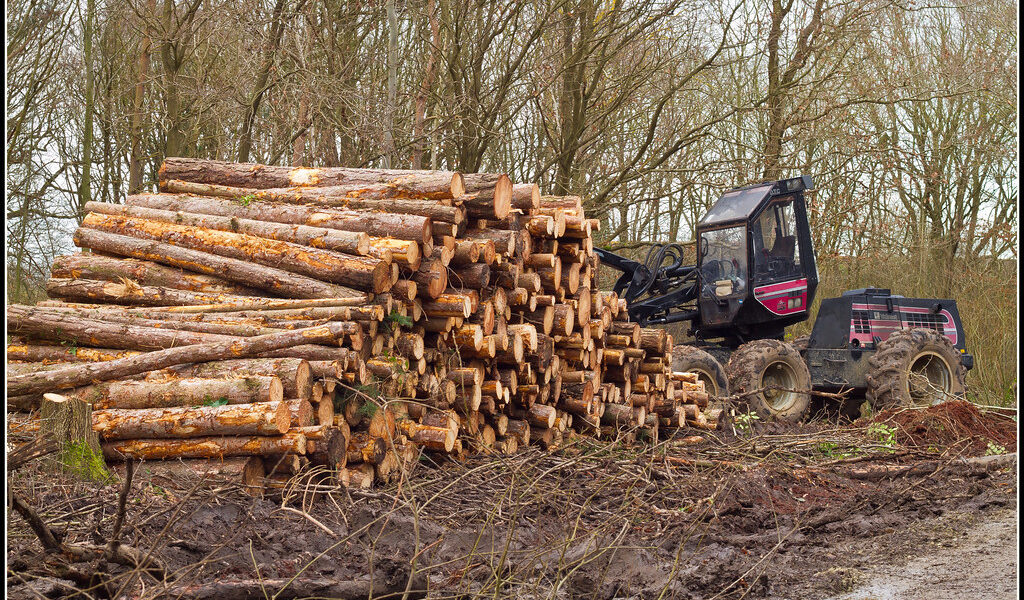
The maintenance manager for a logging contractor in British Columbia noticed something unusual in the end-of-season service data: three of their eight Ponsse Elephant King forwarders had all consumed boom isolation rubber at roughly the same hour interval (1,800 hours), while the other five ran significantly longer. The difference, traced through operator logs, was terrain. The three machines worked steep, rocky clear-cuts where the boom was constantly loaded asymmetrically — one side reaching over obstacles while the other extended to the limit. The uneven loading created combined bending and torsion in the boom’s rubber isolation joints that the standard replacement interval hadn’t accounted for. The fix was a terrain-adjusted inspection schedule: steep rocky terrain triggers rubber inspection at 1,200 hours instead of 2,000 hours.
Forestry machinery operates in conditions that no other equipment category encounters: extreme terrain angles (up to 35°), constant tree root and rock impacts to the undercarriage, chainsaw vibration transmitted through the harvester head attachment, and the biological degradation from prolonged exposure to wood acids, sap, and bark tannins that attack some rubber compounds.
This guide covers the rubber parts inventory for the major forestry machine types — cut-to-length harvesters and forwarders — from the three leading manufacturers: Ponsse (Finland), Komatsu Forest (Sweden/global), and John Deere Forestry.
Need forestry machinery rubber components? Babacan Group stocks rubber mounts and isolation parts for all major forestry machine brands. Request a quote.
Harvester Head Mounting and Isolation Rubber
The harvester head — which fells, delimbs, and bucks trees — is the most complex component of a cut-to-length harvester. It mounts to the crane tip through a rotator (usually hydraulic) and an attachment bracket that incorporates rubber isolation elements.
Rotator Mount Rubber Isolation
The harvester head rotator allows 360° continuous head rotation for optimal tree processing position. Between the rotator body and the crane tip attachment, rubber isolation pads:
- Absorb the percussive vibration from the harvesting head’s feed rollers and delimbing knives
- Prevent high-frequency chainsaw vibration from transmitting back up the crane to the cab
- Allow slight misalignment between the rotator centerline and crane tip axis
Harvester head isolation rubber must resist:
– Wood acid and tannin contact: Freshly cut conifers release terpenes and organic acids (pH 4-5) that attack some compounds
– Chainsaw oil and hydraulic oil: Exposure to both bar oil and hydraulic fluid at the head mounting point
– Temperature cycling: Nordic forest operations range from -40°C in winter to +35°C in summer
Compound specification: CR (chloroprene) or CR/NR blend is standard for harvester head isolation — providing good resistance to both the organic acid environment and the oil exposure, combined with adequate cold-temperature flexibility.
Crane Slewing and Boom Joint Rubber Bushings
The crane that carries the harvester head has multiple pivot and slewing joints, each using rubber-lined bushings or wear pads:
- Main boom pivot bushings: Large-diameter rubber-lined bushings at the crane base slewing pivot and main lift point
- Extension telescope seal: The telescoping boom extension uses rubber wiper seals to prevent bark and dirt contamination
- Knuckle joint bushings: Between the inner and outer crane arms; take the combined bending/torsion loads described in the British Columbia case
These bushings are grease-lubricated in most designs. When grease is absent (missed lubrication intervals are common in the field), rubber-on-pin wear accelerates and the bushing inner sleeve begins to rotate — a progression that leads to rapidly increasing joint play.
Forwarder Bogie and Undercarriage Rubber
Forwarders carry cut logs from the harvesting site to the roadside landing. They carry payloads of 12-20 tonnes over ground that has been disrupted by the harvester — root cavities, slash piles, soft patches. The rubber undercarriage components must absorb this constant shock loading.
Bogie Frame Pivot Rubber
Ponsse and Komatsu Forest forwarders use a bogie frame (two axles per bogie, four bogies per machine) that oscillates independently over terrain. The bogie pivot to the machine frame uses:
- Pivot bushing: Large rubber-bonded metal bushing; allows ±15° bogie oscillation under full payload
- Pivot rubber stops: Limit bogie travel at maximum oscillation; absorb the impact when the bogie hits its travel limit on extreme terrain
Bogie pivot bushing replacement is a major service task requiring the machine to be jacked and the bogie partially removed. Service life targets are 3,000-5,000 hours but vary significantly with terrain severity.
John Deere Forwarder Swing Axle Rubber
John Deere 1110G and 1210G forwarders use a swing axle design on the rear frame. The swing axle pivot uses rubber-cushioned bearings that:
– Allow the rear frame to oscillate independently of the front frame (±20°)
– Absorb lateral load from side-hill operation
The swing axle rubber requires periodic preload measurement — as the rubber ages and compression-sets, the axle mounting loosens and axle play increases.
Cab Isolation: Managing Extreme Terrain Vibration
Forestry machine operators face some of the highest whole-body vibration exposures of any equipment category. The combination of uneven ground, heavy loads, and equipment working at speed creates vibration spectra that are difficult to isolate.
Ponsse Cab Mounting System
Ponsse mounts its cab on a hydraulically stabilized system that provides active leveling (keeps the cab horizontal on slopes up to 35°) plus passive rubber isolation from vibration. The rubber mounts in this system:
- Must maintain function while accommodating the active leveling system’s movement range (±20° in the Ponsse system)
- See combined static loading (cab weight) and dynamic loading (active leveling hydraulic forces)
- Operate in the full Nordic temperature range
Ponsse cab isolation mounts are designed for approximately 3,000 hours service life. In steep terrain operations, expect 2,000-2,500 hours. Ponsse’s own telematics system (Ponsse MaxiVision) can be used to monitor machine inclination statistics — high average inclination correlates with faster cab mount wear.
Komatsu Forest Comfort Cab Rubber
Komatsu Forest’s comfort cab system uses six-point rubber-metal isolation mounts with a secondary isolation layer for the operator seat mounting. The two-stage isolation provides:
– Stage 1 (cab mounts): Attenuates 15-100 Hz structural vibration from the chassis
– Stage 2 (seat mounts): Attenuates low-frequency chassis motion (3-8 Hz) from bogie bounce
When cab mounts degrade, the stage 2 seat suspension operates at higher input amplitudes and reaches its stroke limits more frequently — the operator perceives this as a “harder ride” rather than identifying the cab mounts as the source.
For broader context on vibration isolation principles applicable to forestry equipment, see our anti-vibration mount selection guide.
Frame Articulation Rubber
Cut-to-length harvesters and forwarders are articulated machines — the front frame (engine, crane) and rear frame (load area or harvester head) are connected by a rubber-cushioned articulation joint.
Central Articulation Rubber
The central articulation hinge uses the same pivot bushing design as other articulated machines, but with forestry-specific modifications:
- Impact resistance: Tree stems and logs frequently strike the area around the articulation joint; protection plates and robust rubber mounting needed
- Contamination resistance: Bark, sawdust, and tree sap accumulate in the articulation area; rubber seals must resist swelling from organic compound contact
- Cold-temperature function: Nordic forestry machines must articulate freely at -40°C; rubber compounds must retain adequate flexibility at this temperature
The low-temperature requirement is the most demanding specification for Nordic forestry rubber. Standard NR compounds lose flexibility below -25°C. Low-temperature grades of NR or NR/CR blends with added plasticizers maintain function to -40°C.
Oscillation Frame Rubber Stops and Cushions
At maximum articulation and oscillation angles, rubber stops limit travel and absorb the impact of the machine reaching its geometric limits. In forestry machines working steep terrain, these stops contact their hard points more frequently than equivalent construction equipment — sometimes multiple times per minute during steep sideslope traversal.
Hydraulic System Rubber for Forestry Machines
Forestry machines run complex hydraulic systems: crane hydraulics, head hydraulics, traction drive, bogie oscillation, cab leveling. The rubber seals and hoses in these systems must handle:
- Hydraulic oil contaminated with wood particles: Sawdust and bark penetrate hose connections and spool valve ports
- Phosphate ester hydraulic fluids: Some fire-resistant hydraulic fluid specifications (required in some countries for forestry machines due to fire risk) require FKM seals rather than standard NBR
Fire-resistant hydraulic fluid compatibility is a key sourcing consideration. Many forestry machines in Europe use Quintolubric or similar phosphate ester fluids. Using NBR seals with these fluids causes rapid seal swelling and system failure.
Wood Acid Resistance: A Forestry-Specific Requirement
The wood acid exposure in forestry machinery is unique to this equipment category. Fresh conifer wood releases:
– Terpenes: Organic solvents that can swell certain rubber compounds
– Weak organic acids (pH 4-5): Attack natural rubber over extended exposure
– Resin/pitch: Adheres to rubber surfaces, promoting surface cracking from thermal cycling
Rubber components near the harvester head and wood contact zones should be specified in CR, EPDM, or CR/NR blends. Pure NR compounds in direct wood contact zones show 30-50% shorter service life than CR in Nordic forestry conditions.
For further guidance on rubber compound selection across different equipment environments, see our broader rubber parts guide for agricultural machinery.
Replacement Intervals for Nordic vs Temperate Operations
The temperature and terrain differences between Nordic (Finland, Sweden, Norway) and temperate (Central Europe, Pacific Northwest) forestry operations significantly affect rubber service life:
| Component | Nordic (steep/cold) | Temperate (moderate) |
|---|---|---|
| Harvester head isolation | 1,200-1,800 hrs | 2,000-3,000 hrs |
| Bogie pivot bushings | 2,500-3,500 hrs | 4,000-5,000 hrs |
| Cab isolation mounts | 2,000-2,500 hrs | 3,000-4,000 hrs |
| Articulation bushings | 2,000-3,000 hrs | 3,500-5,000 hrs |
| Hydraulic hoses | Annual | 3-5 years |
| Crane knuckle bushings | 1,500-2,000 hrs | 2,500-3,500 hrs |
Babacan Group manufactures forestry equipment rubber components under ISO 9001:2015 quality management. Our range covers Ponsse Elephant, Bear, and Scorpion series; Komatsu Forest 845, 855, and 865 series; John Deere 1110G, 1210G, and 1510G series. Browse our rubber parts catalog or request a quote.
Conclusion
Forestry equipment rubber parts face environmental demands — wood acids, extreme cold, steep terrain vibration — that no other equipment category matches. The rubber compound specification is as important as the dimensional specification: the wrong compound in a wood-acid environment, or an inadequately cold-rated compound for Nordic operations, can reduce service life by 40-60%.
Key takeaways:
– Wood acid resistance requires CR or CR/NR blend compounds — not pure NR near harvester head contact zones
– Nordic operations need rubber rated to -40°C; standard compounds fail below -25°C
– Terrain severity (steep rocky vs. gentle) should drive inspection intervals, not just operating hours
– Fire-resistant hydraulic fluids (phosphate esters) require FKM seals — always verify fluid specification before sourcing seal kits
Babacan Group ships forestry equipment rubber parts to logging contractors and forestry machine dealers in 84+ countries. Request a technical quote for your Ponsse, Komatsu Forest, or John Deere forestry machine model.