
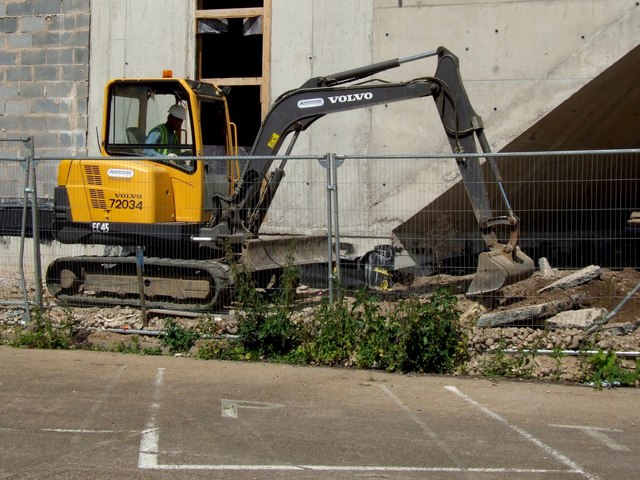
A civil contractor running a Volvo EC480E noticed his machine was burning fuel at a rate 8% above the fleet average for comparable work. Engine diagnostics showed no fault codes, fuel system checks were normal, and the injection system tested within spec. A Volvo field technician suggested checking engine mount condition during the investigation.
Two of the six engine mounts had failed — one with complete rubber-to-metal separation. The engine was sitting slightly out of its designed position, causing a misalignment between the engine output shaft and the hydraulic pump input. The pump was working harder to maintain pressure, and the slight angular misalignment was creating additional heat in the coupling. Together these added up to the unexplained fuel consumption increase.
New engine mounts: $480. Restored fuel efficiency: saved the contractor over $3,200 in fuel costs over the following 1,000 hours.
Volvo Construction Equipment is known for operator comfort and fuel efficiency — both of which depend significantly on the condition of the rubber isolation components throughout the machine. This guide covers the rubber parts in Volvo EC excavators and L-series wheel loaders that require regular maintenance.
Volvo CE Rubber Component Philosophy
Volvo Construction Equipment designs their machines with more rubber isolation points than most Japanese competitors of comparable weight class. A Volvo EC380E uses 8 cab mount points where a Komatsu PC360-8 uses 4–6. This higher mount count allows softer individual mounts — lower stiffness per mount — while maintaining the same overall isolation performance.
The advantage: better operator comfort and lower transmitted vibration to the cab structure. The maintenance implication: more mounts to inspect and replace, but each individual mount carries a lower load and theoretically has a longer service life when correctly specified.
EC Series Excavators: Rubber Components by Model
EC220 Series (EC220D, EC220E, EC220F)
The EC220 is Volvo’s primary 22-tonne class excavator, competing against the Komatsu PC210 and CAT 320.
Engine mounts: 4-point system using sandwich-style mounts. The EC220E uses the D5K engine — lighter than the D6E used in EC250/EC300 class, so load ratings on EC220 engine mounts are lower than mid-size class.
Cab mounts: 6-point system. Volvo EC220 cab mounts use a stud-type design — the rubber element is vulcanized around a central stud that threads into the cab floor. The stud threads are a common maintenance issue: corrosion on the stud threads (particularly in coastal environments) can seize the stud into the cab floor, making mount removal difficult without damaging the cab mounting rail.
Prevention: coat stud threads with anti-seize compound at every mount replacement. If replacing mounts on a machine with corrosion history, plan for stud extraction tools in your service kit.
EC300 and EC350 Series
Mid-size Volvo excavators with more robust rubber mount requirements:
Engine mounts: 6-point system with the D8K/D8N engine. Volvo changed the engine mount specification at the transition from EC300D to EC300E — D-series and E-series engine mounts share similar dimensions but have different dynamic stiffness specifications. Cross-referencing between generations without stiffness verification is not recommended.
Hydraulic pump coupling: Volvo EC300/EC350 uses a single main hydraulic pump on standard configurations (dual pump on high-flow option). The coupling element between engine and pump is a disc-type rubber element.
Service note: Volvo EC series pump couplings have a designated inspection window in the bell housing — remove the inspection plug every 1,000 hours to visually check coupling element condition without full disassembly.
EC380 and EC480 Series
Large Volvo excavators commonly used on infrastructure and quarry applications:
Engine mounts: 6-point mounting, higher load rating than EC300 series. D13 engine weight is approximately 1,850 kg — significantly more than lighter class machines.
Cab mounts: 8-point system with progressive-rate rubber compound. The progressive rate is particularly important on EC480 — the larger superstructure mass means larger cab movement amplitudes in response to travel vibration, which would stress a linear-rate mount.
Swing circle isolation (some configurations): EC480 configurations for demolition and sorting applications sometimes include rubber isolation elements in the swing circle mounting to reduce upperstructure vibration transmission. These are not present on standard excavator configuration.
EC950 and EC950F (Large Mining Excavator)
The EC950 is Volvo’s large mining class excavator. Rubber component specifications at this weight class are factory-engineering documents. Provide machine serial number when requesting specifications.
L-Series Wheel Loaders: Rubber Components
L60 to L90 Series (Compact and Small Wheel Loaders)
Axle oscillation bushing: Single front axle oscillation point with rubber bushing. At this size class, the bushing is accessible and straightforward to replace — 2–3 hour job.
Engine mounts: 3–4 point system with smaller load ratings than larger wheel loaders.
Cab mounts: 4-point system, lower load ratings.
Service life expectation at normal duty: engine mounts 8,000–10,000 hours; cab mounts 6,000–8,000 hours.
L120 to L180 Series (Medium Wheel Loaders)
The most common Volvo wheel loader size class — L120H through L180H are used extensively in quarrying, waste handling, and port operations.
Front axle oscillation bushing: This is the highest-consequence rubber component on L-series wheel loaders. It carries the full front axle load while allowing the axle to oscillate as the machine travels over uneven ground. Volvo specifies inspection at every 1,000 hours.
On L150 and L180, the oscillation bushing is a two-piece assembly — a rubber-lined bushing pressed into the front axle oscillation housing, plus a steel sleeve on the oscillation pin. Both the bushing and the sleeve must be inspected. Worn sleeve on new bushing = the bushing will wear rapidly from the irregular surface.
Rear axle trunnion bushings: L-series wheel loaders use a rear axle that is fixed (no oscillation) but mounted through rubber trunnion elements that allow slight compliance. These carry high loads but cycle less than the front axle oscillation system.
Cab mounting system: L-series wheel loaders use a cab-over-engine layout with the cab sitting on isolation mounts above the engine compartment. This places the cab mount isolation system in a higher-temperature environment than on excavators — temperature-rated rubber compounds are required here.
L220 to L350 Series (Large Wheel Loaders)
Large Volvo wheel loaders used in quarrying, port operations, and large-scale construction:
Hydraulic cab suspension (L250H and above): These models use active hydraulic cab suspension instead of passive rubber mounts — an oil-filled cylinder adjusts to filter low-frequency vibration. This system has rubber seals and accumulators that require periodic service (different from the passive mount replacement schedule on smaller machines).
Articulation joint rubber cushions: The articulation joint between front and rear frames on large wheel loaders uses rubber cushion elements to limit metal contact at articulation extremes. These wear from repeated impacts at full articulation lock — common in tight-space loading operations.
Common Volvo CE Rubber Parts Maintenance Issues
Metric Thread Variants
Volvo CE uses metric hardware throughout, but some early-generation machines (pre-2010) used non-standard metric thread pitches on mount studs. Before ordering replacement hardware, measure thread pitch with a thread gauge — M12x1.5 and M12x1.75 look identical to the naked eye but are not interchangeable.
Stud Corrosion
As noted for EC220, stud-type cab mounts on Volvo CE machines are prone to stud thread corrosion in humid and coastal environments. This is not unique to Volvo but is more common due to the stud design. Include stud inspection and anti-seize application in every service that accesses the cab mounts.
Volvo Compatible Aftermarket Parts
Volvo’s dealer network provides good genuine part availability for current models. For older machines (EC240B, EC290B, EC360B and earlier), genuine part supply becomes inconsistent. Babacan Group maintains Volvo-compatible rubber mount specifications for both current and legacy machine generations.
Our rubber mount catalog includes Volvo EC and L-series references. For specific cross-references by machine serial number, request a quote with your machine details.
Key Takeaways
-
Volvo CE uses more mount points than Japanese competitors — higher mount count allows softer individual mounts, but requires more inspection points at service.
-
EC220 stud-type cab mounts corrode in coastal environments — apply anti-seize to stud threads at every mount replacement.
-
EC300D and EC300E engine mounts are not interchangeable — dynamic stiffness specification changed at generation transition.
-
L-series front axle oscillation bushing is the highest-consequence rubber item on wheel loaders — failure causes secondary damage to axle pin and bore, and affects tire wear.
-
L250H and above use active hydraulic cab suspension — different maintenance procedure from passive rubber mounts on smaller models.
Contact Babacan Group for Volvo CE rubber part specifications or browse our rubber parts catalog.
Word Count: ~1,500 words