
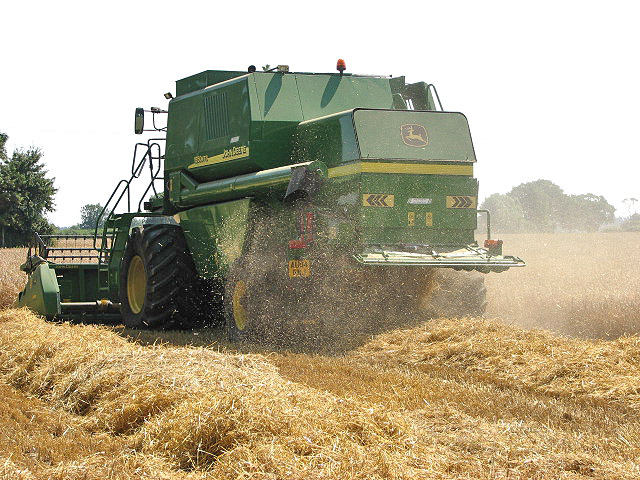
In August 2023, a grain farming operation in Saskatchewan was three days into wheat harvest when their John Deere S790 combine began showing erratic unloading auger behavior — the auger would engage slowly and occasionally slip under load. Investigation during a break found the auger drive belt tensioner rubber cushion had cracked and collapsed. The tensioner spring was now metal-on-metal against its stop, providing inconsistent tension. Replacement: $45. Downtime to diagnose and fix during peak harvest: 4.5 hours. At the operator’s custom cutting rate of $28/acre, 4.5 hours in good conditions represented roughly 180 harvested acres — about $5,000 in missed revenue.
Combine harvesters are among the most mechanically complex agricultural machines, combining harvesting, threshing, separating, cleaning, and grain handling systems in a single self-propelled unit. The rubber components throughout these systems — belt tensioner cushions, threshing drum mounts, feeder house suspension rubber, vibrating sieve isolators, and cab isolation mounts — keep this complexity running smoothly at harvest intensity.
This guide covers the critical rubber parts inventory for the three major combine harvester brands: John Deere S-series and X-series, Case IH Axial-Flow 250 and 280 series, and New Holland CR and CX series. We cover each major system, the rubber components within it, and the specifications and replacement intervals that matter in the field.
Need combine harvester rubber parts? Babacan Group stocks agricultural machinery rubber components for all major brands. Request a quote with your model and system details.
Feeder House and Header Drive Rubber Components
The feeder house — the inclined conveyor that delivers cut crop from the header to the threshing system — is the highest-wear area for rubber components outside the cab system.
Feeder House Suspension Rubber Mounts
The feeder house pivots from the main body on a rubber-cushioned pivot point that allows the header to float and follow ground contours. These pivot mounts:
- Support a dynamic load of 1,500-4,000 kg (header weight varies from 800 kg for a grain header to 3,500 kg for a large corn header)
- Absorb shock when the header encounters embedded rocks or hard spots
- Must maintain consistent geometry for header height control accuracy
On John Deere S-series combines, the feeder house mounting rubber is a proprietary bonded element (OEM reference RE557897 pattern). Excessive wear manifests as header float instability — the automatic float control system cannot maintain consistent ground pressure because the worn mounts allow excessive feeder house movement.
Header Drive Rubber Couplings
The header receives power through a driveline from the combine engine. The connection points use rubber-element flexible couplings (often spider-type or disc-type) that:
- Accommodate slight angular misalignment between combine body and attached header
- Absorb driveline shock when the header reel contacts obstacles
- Prevent driveline resonance from exciting header vibration
These couplings see extreme seasonal stress: relatively light running during the season, then storage through winter, followed by rapid return to high-load harvest operation. Rubber elements that have taken a compression set during storage may not recover to full compliance before harvest begins.
Threshing and Separation System Rubber Parts
Axial Rotor Isolation Mounts (Case IH Axial-Flow)
Case IH Axial-Flow combines use a single large-diameter axial rotor rather than the traditional cylinder/walker design. This rotor — 610 mm (24 in.) diameter, running at 200-1,100 rpm — is supported in rubber-isolated bearings that:
- Damp the imbalance forces as the rotor load changes with varying crop density
- Prevent bearing vibration from transmitting to the body frame (which would create noise and accelerate fatigue cracking)
- Allow slight radial movement to accommodate thermal expansion at operating temperature
Case IH 250 and 280 series axial rotor bearing mounts are critical components. A failed mount on a Casper Van der Berg’s farm in the Netherlands caused rotor bearing failure within 200 operating hours — what looked like a bearing failure was actually a failed mount that allowed the rotor to run with insufficient lateral constraint, overloading the bearing.
Cylinder and Walker Mounting (John Deere, New Holland Traditional Designs)
John Deere S-series and New Holland CR series use multi-drum or rotary separator designs. The threshing cylinder mounting includes rubber isolation elements that:
- Allow the cylinder to rotate freely without transmitting vibration to frame
- Absorb the variable loads as crop density fluctuates through the threshing gap
Cylinder bearing isolation rubber on New Holland CR combines must accommodate the machine’s dual-rotor design (CR = two counter-rotating rotors). The bearing isolation on each rotor is independent; mismatched rubber elements between the two rotors create differential vibration patterns that operators notice as unusual cab vibration at certain rotor speeds.
Cleaning Shoe (Sieves) Vibration Isolation
The cleaning shoe — the oscillating sieves that separate clean grain from chaff — vibrates at 5-8 Hz with an amplitude of 20-30 mm. The mounting system uses rubber isolators between the oscillating shoe frame and the fixed combine body:
- Lateral isolators: Prevent lateral shoe motion from transmitting to the body
- Suspension springs with rubber end pads: Provide the oscillation compliance and limit hard travel
These isolators are among the highest-cycle-count rubber components in the combine. At 6 Hz for 500 hours per season, that is 10.8 million cycles per season. Natural rubber fatigue resistance is essential here — SBR or EPDM compounds lack the fatigue life for this application.
Cab Isolation Systems
Combine harvester operators work 12-16 hour days during harvest, which amplifies the health impact of cab vibration above what EU Vibration Directive calculations for 8-hour shifts assume. Whole-body vibration exposure in combines is a documented occupational health concern in several agricultural research studies.
Cab Mounting and ActiveSeat Systems
Modern John Deere S-series combines use a six-point cab mounting system with softer-than-tractor rubber mounts, because the combine cab sits higher (higher center of gravity) and the machine travels over rougher terrain than road-driving tractors.
The active suspension seats used in premium combine specifications add a hydraulic or electro-mechanical suspension layer above the rubber cab mounts. When rubber cab mounts degrade:
- The active seat works harder and reaches its stroke limits more frequently
- Operator vibration exposure increases
- The seat suspension control system may report faults as the input accelerations exceed its design range
Inspection priority: Combine cab mounts should be inspected annually, ideally before harvest season, as a degraded mount discovered mid-harvest cannot be repaired without taking the machine out of service.
Rooftop and HVAC Isolation
The combine cab rooftop carries the air conditioning condensing unit and a large grain tank alarm display. These are isolated from the cab roof with rubber mounts. Worn isolation allows HVAC vibration to enter the cab interior, which operators experience as an annoying buzz at idle rpm — often mistaken for a loose panel.
Grain Handling System Rubber Components
Unloading Auger Drive Components
The unloading auger — which transfers grain from the tank to a cart alongside the combine — uses a rubber-cushioned drive engagement clutch on most modern combines. The rubber cushion:
- Absorbs the engagement shock when the auger engages under load
- Prevents shock from propagating to the auger tube mounting structure
The Saskatchewan case at the opening of this article illustrates the consequence of this apparently minor component failing during harvest.
Clean Grain and Returns Elevator Seals
The bucket elevators that move clean grain and unthreshed returns use rubber boot seals at the top and bottom of the elevator housings. These seals:
- Prevent grain from escaping at the elevator housing joints
- Seal against dust and rain entry
- Allow thermal expansion of the elevator housing
Elevator boot seals are inexpensive ($15-30 each) but when they harden and crack, the resulting grain loss and dust entry into elevator bearings cause expensive downstream failures.
Hydrostatic and Mechanical Drive Rubber Components
Modern combines use hydrostatic ground drives and mechanical drives to the cutting and threshing systems. The rubber components in these drive systems include:
Hydrostatic Pump and Motor Mounts
The hydrostatic drive pump mounts to the engine through rubber-isolated brackets that:
– Damp pump pressure pulsation noise
– Allow slight pump-to-engine alignment tolerance
– Prevent hydraulic pump resonances from exciting combine body panels
Pump mount wear is detectable as increased hydraulic noise — a characteristic whine that increases in frequency when mount natural frequency drops into the pump excitation range.
CVT/Ground Drive Belt Tensioners
Many combines use belt-driven intermediate drives with rubber-cushioned belt tensioners. These tensioners maintain constant belt tension despite varying belt stretch and thermal expansion. The rubber cushion in the tensioner:
- Provides the compliance that allows the tensioner to follow belt length variation
- Absorbs belt slack shock during engagement
- Service life: 500-1,500 operating hours depending on dust and thermal exposure
Our agricultural machinery rubber parts guide provides additional context on rubber components across harvesting systems.
Seasonal Maintenance Planning
Combine harvesters typically operate in intense seasonal bursts (300-600 hours per year in most markets) rather than year-round. This creates a specific maintenance planning pattern:
Pre-Harvest Inspection (Critical)
Items to inspect before the season begins:
1. Cab isolation mounts — visual and deflection check
2. Feeder house pivot rubber — lateral play measurement
3. Rotor or cylinder isolation bearings — visual inspection for rubber extrusion
4. Cleaning shoe suspension isolators — deflection uniformity
5. Belt tensioner rubber cushions — compression set check
End-of-Season Replacement Strategy
Replacing rubber components at season end (rather than at failure during harvest) prevents harvest downtime and allows unhurried repair. Components to consider for end-of-season replacement:
- Any mount showing Shore A hardening above nominal +10 Shore A
- Belt tensioner cushions with visible cracking
- Elevator boot seals showing hardening or shrinkage
Sourcing: Brand-Specific vs. Universal Rubber Parts
Case IH, John Deere, and New Holland maintain proprietary designs for several key rubber components — particularly feeder house pivot mounts and rotor bearing isolation. These benefit from OEM-compatible sourcing where possible.
For more standard components (tensioner cushions, elevator seals, sieve isolation mounts), broader-specification aftermarket parts that meet the dimensional and hardness requirements are equally functional. For guidance on this decision, see our OEM vs. aftermarket rubber parts analysis.
Babacan Group manufactures combine harvester rubber parts under ISO 9001:2015 quality management. Our agricultural parts database covers John Deere S, T, and X series combines; Case IH Axial-Flow 150, 250, and 280 series; New Holland CR, CX, and TC series. Browse our rubber parts catalog or request a quote.
Replacement Interval Summary
| Component | Inspect | Replace |
|---|---|---|
| Feeder house pivot mounts | Pre-season | 2,000-3,000 hours or on condition |
| Rotor/cylinder isolation | Pre-season | 1,500-2,500 hours |
| Cleaning shoe isolators | Pre-season | 2,000-3,000 hours (10M+ cycles) |
| Cab isolation mounts | Pre-season | 2,500-4,000 hours |
| Belt tensioner cushions | Pre-season | 500-1,500 hours |
| Elevator boot seals | Pre-season | 1,000-2,000 hours |
| Header drive couplings | Pre-season | On condition |
Conclusion
Combine harvester rubber parts connect dozens of high-intensity mechanical systems. A $45 tensioner cushion stops harvest. A $180 feeder house pivot mount affects header control accuracy. The pattern repeats throughout the machine: small rubber components with disproportionate impact on harvest performance and uptime.
Key takeaways for maintenance managers and combine operators:
– Pre-harvest rubber inspection prevents mid-harvest failures — inspect every isolated mount before the season
– Cleaning shoe isolator fatigue life is limited by cycle count more than time or hours — high-capacity machines accumulate fatigue faster
– Combine cab mounts degrade the active seat system’s effectiveness when they deteriorate
– End-of-season replacement of borderline components eliminates the worst-timing failures
Babacan Group ships combine harvester rubber parts to agricultural contractors and dealers in 84+ countries. Request a technical quote for your specific model.