
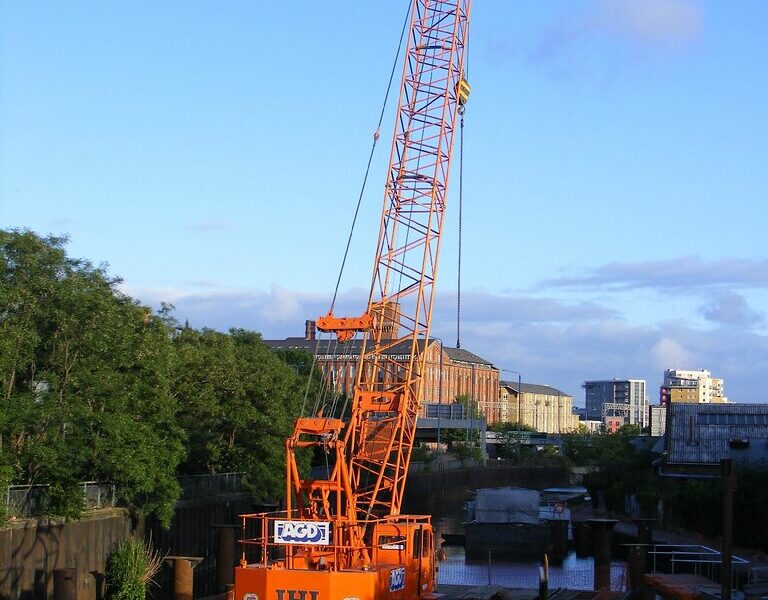
A lift coordinator at a wind farm construction project in northern Germany called an emergency stop during the main lift of a 90-tonne wind turbine nacelle. The Liebherr LR 1750 crawler crane — rated to 750-tonne capacity — was at 60% of its rated load chart when the LICCON crane management system flagged an unusual slewing resistance alarm during a slow superstructure rotation. Investigation found the slewing ring gear pinion drive rubber coupling had partially failed, creating irregular torque transmission to the slewing ring. Uneven torque delivery creates micro-shocks in the slewing drive — and on a crane carry lift, even micro-shocks in the superstructure can disturb load stability. The lift was aborted and the coupling rubber replaced. The coupling element cost: $620. The cost of a disrupted 30-person lift crew for a half-day: considerable. The cost of a load stability incident during a wind turbine nacelle installation: potentially catastrophic.
Crawler cranes — with their tracked undercarriage, massive lifting capacity, and complex superstructure — contain rubber components in positions that directly affect both machine integrity and lifting safety. From the slewing drive coupling to the carbody isolation mounts, this guide covers rubber parts for the major crawler crane manufacturers: Liebherr (LR series), Manitowoc, and Grove.
Babacan Group manufactures crawler crane rubber components with full traceability for critical lifting applications. Request a quote for your crawler crane model.
Superstructure and Carbody Rubber Interfaces
Slewing Ring Drive Coupling Rubber
The crawler crane slewing system — which rotates the superstructure (boom, hook, counterweight, and cab) above the carbody — uses rubber couplings or rubber-element couplings in the drive train between the slewing motor and the slewing ring pinion. These coupling elements:
- Absorb torque peaks when slewing acceleration starts or stops suddenly
- Prevent the motor’s torque oscillation from transmitting as impact load to the slewing ring teeth
- Allow slight angular misalignment between motor shaft and pinion
The wind farm case above illustrates the lifting-safety consequence of slewing coupling rubber failure. The LICCON system detected the irregular slewing torque — without such monitoring, the failure mode could have progressed to complete coupling failure during a loaded slew.
Slewing drive coupling rubber specifications for Liebherr LR series:
– Compound: NBR or polyurethane for oil-resistant applications
– Shore A/D: 75-85 Shore A (firm coupling elements for positive torque transmission)
– Replacement interval: 4,000-6,000 hours or on any detection of irregular slewing behaviour
Carbody-to-Superstructure Interface Rubber
Many crawler cranes incorporate rubber isolation pads at the slewing ring attachment to reduce vibration transmission from the tracked undercarriage (which contacts ground surface irregularities during repositioning) to the superstructure. These pads:
– Shore A: 45-60
– Function: Attenuate ground-transmitted vibration from crawler travel to superstructure electronics and precision components
– Critical on cranes with sensitive load monitoring systems
Undercarriage: Tracked System Rubber
Track Tension Rubber Buffers
Crawler crane tracks use idler recoil springs (often with rubber buffers) to absorb rock and debris impacts that could damage the track chain. The rubber buffers:
– Absorb peak impact loads from objects jamming between sprocket and track
– Allow the front idler to recoil without track derailment
– Compound: NR or NR/SBR, Shore A 55-70
On large crawler cranes (LR 1300, LR 1750, Manitowoc 2250), the track tension system uses hydraulic tension cylinders rather than mechanical spring buffers — but rubber sealing of these cylinders follows the same hydraulic seal specifications as other large equipment.
Final Drive and Travel Motor Sealing
Crawler crane travel drives — used for crane repositioning — use the same Duo-Cone floating face seal architecture as large excavators. Final drive Duo-Cone O-ring specifications:
– Compound: NR
– Shore A: 68-72
– Dimensional tolerance: ±0.1 mm critical for face seal preload maintenance
Travel distance is very low for crawler cranes (cranes reposition short distances on site, rarely travel on public roads), but travel motor sealing must exclude mud and ground water during wet site conditions — common in foundation and infrastructure work.
Track Pad Rubber
Crawler cranes working on finished surfaces (factory floors, paved aprons, airport runways) use rubber track pads to protect the surface from steel track damage. Track pad rubber specifications for large crawler cranes:
– Pad size: Larger than excavator pads — LR 1750 track shoes are 900 mm-1200 mm wide
– Compound: Abrasion-resistant NR for walking and manoeuvring on hard surfaces
– Retention: Pad must not detach during travel — retention bolt specifications are part of pad design
Engine and Powertrain Isolation
Crawler Crane Carrier Engine Mounts
Large crawler cranes use diesel engines from 300 kW (smaller LR models) to over 1,000 kW (LR 11000). Engine mount specifications scale with power:
Liebherr LR 1300 (Liebherr D9508 diesel, 440 kW):
– Shore A: 55-65
– Compound: NR with heat stabilization
– Mount quantity: 6-point system
Liebherr LR 1750 (Liebherr V12 engine, 750 kW):
– Shore A: 60-70
– Compound: High-temperature NR — engine compartment temperatures at 750 kW demand thermal stability
– Mount quantity: 8-point system
Manitowoc MLC650 / MLC300 (various diesel, 350-750 kW range):
– Similar Shore A range to equivalent Liebherr models
– Compound: NR/SBR for oil resistance in dense engine compartment
Slewing Motor and Winch Motor Isolation
On large crawler cranes with multiple slewing motors and main/auxiliary winch motors, each motor is mounted on rubber anti-vibration mounts to reduce vibration transmission to the superstructure:
– Shore A: 45-55 for winch motor mounts
– Slewing motor mounts: Shore A 50-60 (stiffer — must maintain motor alignment with slewing ring pinion)
Cab Isolation for Crawler Cranes
Crawler crane operator cabs face a dual isolation challenge:
1. Ground-surface vibration during crane repositioning (travel phase)
2. Superstructure vibration during lifting operations (slewing, hoisting)
Liebherr LR Cab Mount System
Liebherr LR cabs are sophisticated with large LICCON display screens, air-conditioned operator environments, and camera monitoring systems. The cab mount system:
– Mount quantity: 4-6 positions
– Front mounts: Shore A 38-48 (soft — primary vibration attenuation at operator position)
– Rear mounts: Shore A 48-58 (stiffer — structural support)
– Special requirement: Mounts must accommodate cab luffing (backward tilt) for boom visibility on LR models with cab luff option
The LICCON system on Liebherr LR cranes monitors vibration. Excessive cab vibration that triggers LICCON sensor flags is a diagnostic indication that cab mount replacement is due — even before the operator notices audible or tactile vibration.
Manitowoc MLC Cab Mounts
Manitowoc MLC-series crawler cranes use similar cab isolation architecture. The Manitowoc CCS (Crane Control System) provides similar vibration monitoring capability to Liebherr’s LICCON.
Counterweight Mounting Rubber
Large crawler cranes carry superstructure counterweights up to several hundred tonnes. The counterweight attaches to the superstructure through:
– Rubber-cushioned pin connections (absorb counterweight set-down impact)
– Stack cushion rubber between counterweight sections (multi-section counterweight assemblies)
Counterweight stack cushion rubber specifications:
– Shore A: 60-70 (firm enough to maintain counterweight geometry)
– Load capacity: Must support the weight of all counterweight sections above it
– Compound: NR for weather resistance (counterweights often stored outdoors)
For guidance on mobile crane rubber parts (all-terrain and truck-mounted), see our mobile crane rubber parts guide. For comprehensive crane rubber coverage, see our crane rubber parts and vibration isolation guide.
Shore Hardness Testing for Crane Rubber
Safety-critical crane rubber components should have Shore A hardness documented at each annual inspection:
| Component | New Shore A | Replace Threshold |
|---|---|---|
| Slewing drive coupling | 75-85 Shore A | Any cracking at bond line; irregular slewing noise |
| Cab mounts (front) | 38-48 | >65 or <28 |
| Engine mounts | 55-70 | >82 or bond separation |
| Body buffer pads | 55-65 | >75 or metal contact |
| Track tension buffers | 55-70 | >78 or cracking |
Replacement Intervals
| Component | Inspection | Replacement |
|---|---|---|
| Slewing drive coupling rubber | Every 2,000 hrs | 4,000-6,000 hrs or on condition |
| Cab mounts | Annual | 3,000-5,000 hrs |
| Engine mounts | Annual | 3,500-5,000 hrs |
| Duo-Cone O-rings | Every 2,000 hrs | 6,000-8,000 hrs |
| Track pad rubber | Per site move | As worn or required for surface protection |
Quality Requirements for Crawler Crane Rubber
ISO 9001:2015 manufacturing as a minimum. For safety-critical components (slewing drive couplings, counterweight connections, load-path rubber):
– Shore A certificate per lot
– Compound certificate confirming NR or specified compound grade
– Full dimensional inspection report
– Compression set test results for sealing components
Babacan Group supplies crawler crane rubber components with full lot traceability documentation to crane contractors, crane rental companies, and Liebherr/Manitowoc/Grove service centers in 84+ countries.
For related Liebherr rubber parts guidance, see our Liebherr excavator rubber parts guide.
Request a technical quote with your crawler crane model and application details.
Conclusion
Crawler cranes are among the most safety-critical machines in construction and energy infrastructure. Their rubber components — from slewing drive couplings to cab isolation mounts — operate in load paths directly connected to lifting safety. Maintaining these components is not a cost-optimization question but a lifting safety requirement.
Key points for crawler crane rubber maintenance:
– Slewing drive coupling rubber should be inspected at each 1,000-hour service — slewing irregularity is an early failure indicator
– LICCON and CCS vibration monitoring flags are not just electronic annoyances — they indicate mounting system degradation that requires physical inspection
– Counterweight mounting rubber is load-path critical — treat with the same rigor as rigging hardware
– Shore A documentation for all safety-critical components provides the inspection record for lifting equipment compliance
Request a quote for crawler crane rubber parts from Babacan Group — supplied with full traceability documentation.