
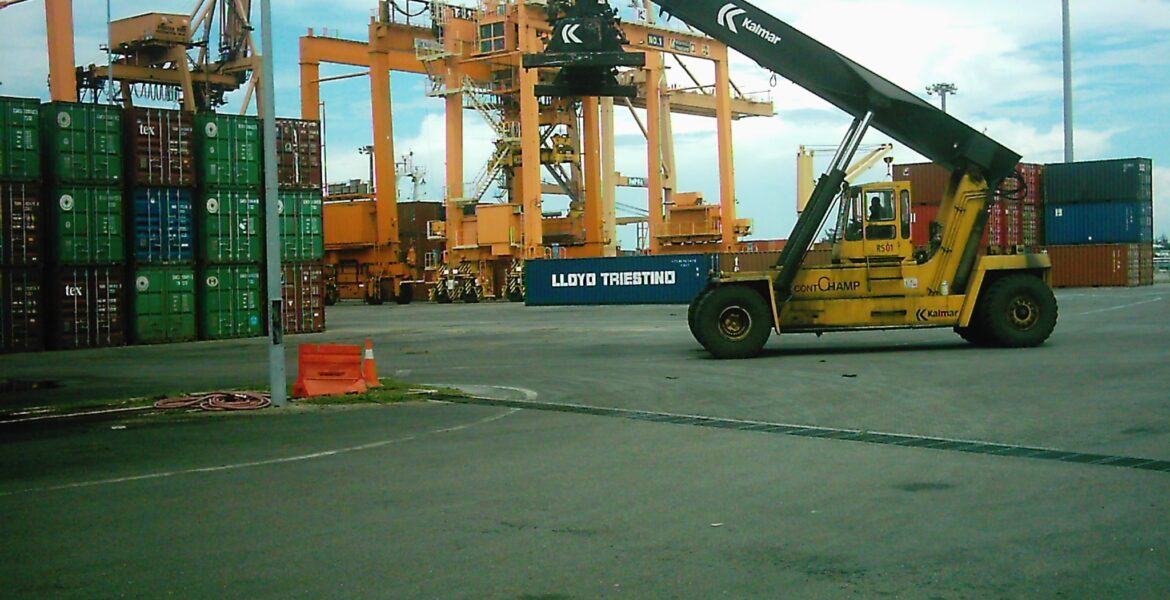
A terminal operations manager at a container port in Valencia, Spain discovered an unusual pattern in their maintenance records: the reach stackers working at the far end of the terminal — the units travelling the longest distances from stack to ship-side — were consuming engine mounts at nearly twice the rate of units working shorter cycle distances. The investigation found a straightforward cause: the long-cycle units spent more time traversing a section of terminal pavement that had subsided slightly, creating a repeating 3-Hz vibration input at travel speed. This vibration frequency was close to the resonant frequency of the engine mount system, driving the mounts to fatigue at accelerated rate. The fix was twofold: repair the pavement section, and replace engine mounts with a slightly firmer compound (Shore A 55 instead of 48) to shift the resonant frequency away from the road-input frequency. A rubber specification change on reach stacker engine mounts — without changing mount dimensions — solved a fleet reliability problem across 12 machines.
Port container handling equipment operates in unusually demanding conditions: near-continuous duty cycles, salt-laden air that accelerates rubber degradation, and heavy loads that place extreme demands on rubber components. Reach stackers, rubber-tyred gantry (RTG) cranes, and ship-to-shore (STS) cranes all depend on rubber isolation and sealing components for reliable operation.
Need port equipment rubber parts? Request a quote from Babacan Group — OEM-specification rubber, 84+ countries.
Reach Stacker Rubber Parts
Reach stackers are among the most intensively used rubber-tyred machines in port operations — continuous duty, heavy loads, and significant travel distances.
Reach Stacker Engine Mounts
Kalmar, Konecranes, and Liebherr reach stackers use diesel engines ranging from 250 kW to 400 kW depending on capacity. Engine mount specifications:
Kalmar DRF 450 (420 kW engine):
– Shore A: 50-58
– Compound: NR/SBR with marine atmosphere resistance (salt spray resistance requirement)
– Mount quantity: 4-6 point
– Note: Salt-spray environments accelerate NR surface oxidation — ozone-resistant compound or EPDM/CR option
Konecranes RS46 (Volvo TAD1370 engine, 350 kW):
– Shore A: 48-56
– Temperature range: -30°C to +105°C standard
Marine salt air accelerates rubber oxidation on exposed engine mount rubber. For port equipment working outdoors, CR (neoprene) or EPDM compounds with ozone resistance are preferable to plain NR for exposed elements. Internal rubber (in enclosures) can use standard NR.
The Valencia case illustrates another key principle: resonant frequency matching between road input and mount natural frequency is a real failure mode, not just theoretical. When site conditions change (pavement settlement, new haul routes), mount specification review may be warranted.
Reach Stacker Cab Isolation Mounts
Reach stacker cabs are elevated — 3-4 metres above ground level on full-size machines. At this height, any chassis pitch amplifies significantly at the cab. Cab mount specifications:
– Shore A: 38-48 (front), 46-56 (rear)
– Compound: CR or EPDM for marine atmosphere ozone resistance
– Temperature: -30°C to +100°C standard
Reach Stacker Boom and Spreader Hydraulic Seals
The telescopic reach boom extends to stack containers up to 6-high. The boom hydraulic cylinders (both main lift and reach extension) experience high cycle counts in intensive terminal operations. Seal specifications:
– Rod seal: Polyurethane lip seal for high-cycle lift operations
– Piston seal: Double-acting NBR or polyurethane
– Guide ring: PTFE-composite for low friction during frequent extension/retraction
– Replacement interval: 3,000-5,000 hours depending on duty intensity
Tyre Mounting and Drive Axle Rubber
Reach stackers use large pneumatic tyres (1800 or 2100 series) with rubber valve stems and bead seating rubber. Drive axle sealing:
– Hub oil seals: NBR compound in standard conditions, FKM for high-temperature axle applications
– Planetary drive O-rings: NBR for gear oil
Rubber-Tyred Gantry (RTG) Crane Rubber Parts
RTG cranes span 6-8 container rows and travel on rubber-tyred wheel bogies along the container yard. They are unique in being very large (18-30 metre span) but rubber-tyred, combining the vibration challenges of wheeled equipment with the lifting requirements of overhead cranes.
RTG Wheel Drive Motor Isolation
RTG cranes use electric motors in each bogie position for travel. The electric motor isolation mounts:
– Shore A: 45-55 (motorized bogies — moderately soft for vibration isolation)
– Compound: NR or EPDM for outdoor weather resistance
– Special requirement: RTG cranes operate outdoors continuously — UV and ozone resistance required
RTG Crane Structural Rubber Joints
The RTG crane structure — especially the gantry beams and corner connections — uses rubber pads at structural expansion joints and beam seat connections. These pads:
– Distribute structural loads evenly across beam seats
– Accommodate thermal expansion of the large steel structure (temperature variation up to 60°C in tropical and temperate port environments)
– Compound: EPDM for outdoor temperature stability and ozone resistance
RTG Hoisting Gear Coupling Rubber
The main hoist motor-to-gearbox coupling on RTG cranes uses flexible rubber or rubber-disc coupling elements to:
– Absorb motor torque spikes during load lifting
– Protect the gearbox from motor transients
– Allow small misalignment between motor shaft and gearbox input
RTG hoist coupling rubber: Shore A 70-80, NBR compound for oil resistance. Replacement interval: 3,000-5,000 hours or on detection of irregular hoisting noise.
RTG Cab Isolation
RTG crane operator cabs travel along the span of the gantry, monitoring container stacking. RTG cab isolation mounts:
– Shore A: 38-50
– Compound: EPDM for outdoor environment
– Special requirement: Cabs must isolate both structural vibration from the gantry and drive motor vibration from bogie travel
Ship-to-Shore (STS) Crane Rubber Parts
STS cranes are the largest machines in a container terminal — fixed rail-mounted structures up to 100 metres tall, lifting containers from ship to quayside. Their rubber components are limited to specific roles: structural vibration damping and machinery isolation.
STS Crane Bogie Wheel Rubber
STS cranes travel on rail bogies with rail wheels. The rail bogie suspension uses rubber pad elements between the bogie frame and the crane leg:
– Function: Isolate crane structure from rail joint impacts during travel
– Compound: NR or CR
– Shore A: 55-65
– Special requirement: Rail pad rubber must accommodate the large forces generated by an 800-1,200 tonne crane structure
STS Machinery House Rubber Isolation
The STS crane machinery house (containing the main hoist motors, drum assemblies, and gearboxes) mounts on rubber-isolation pads to prevent machinery vibration from transmitting to the structural steelwork:
– Anti-vibration pads under motor/gearbox sets: Shore A 45-60
– Compound: NR or EPDM
– Special: High sustained load — hoist motors may be rated to 1,000 kW+
STS Electrical Room Rubber Floor Isolation
STS cranes carry large electrical rooms with inverter drives, transformers, and control systems. These rooms are mounted on rubber-isolation pads:
– Shore A: 35-48 (soft — protect sensitive electronics from structural vibration)
– Compound: EPDM for fire-resistance consideration
– Function: Primarily isolate switching transients and structural-borne noise from electronics
For crane rubber guidance covering mobile cranes and other crane types, see our mobile crane rubber parts guide and crane rubber parts and vibration isolation guide.
Salt Atmosphere Rubber Compound Selection
Port equipment operates in one of the most challenging environments for rubber — continuous salt air exposure combined with UV radiation, temperature cycling, and ozone from electrical equipment.
Compound recommendations for port environment:
– EPDM: Best ozone and UV resistance, good temperature range. Use for exposed outdoor rubber (cab mounts, structural pads, profiles)
– CR (Neoprene): Good oil and weather resistance. Use for components in mixed oil/weather exposure
– NBR: Standard for hydraulic oil applications. Not suitable for outdoor exposed elements (poor ozone resistance)
– FKM (Viton): High-temperature and chemical resistance. Use for drive motor seals with elevated operating temperatures
The vibration isolation principles that apply to standard construction equipment also apply to port machinery — the key additional factor in port environments is compound durability against salt, ozone, and UV degradation.
Shore Hardness Testing for Port Equipment
| Component | Target Shore A | Replace Threshold |
|---|---|---|
| Reach stacker engine mounts | 48-58 | <35 or >72 |
| Reach stacker cab mounts | 38-48 | <28 or >62 |
| RTG hoist coupling | 70-80 Shore A | Cracking or irregular hoist noise |
| STS bogie rail pads | 55-65 | >78 or cracking |
Replacement Intervals
| Component | Interval (Standard Port Duty) |
|---|---|
| Reach stacker engine mounts | 3,000-4,000 hrs |
| Reach stacker cab mounts | 3,000-3,500 hrs |
| Reach stacker hydraulic seals | 3,500-5,000 hrs |
| RTG hoist coupling rubber | 3,500-5,000 hrs |
| RTG bogie motor isolation | 5,000-7,000 hrs |
| STS bogie rail pads | 7,000-10,000 hrs |
Conclusion
Port container handling equipment operates in demanding conditions that require rubber compounds with marine atmosphere resistance alongside the standard mechanical and thermal performance requirements.
Key points for port equipment rubber maintenance:
– Salt air requires ozone and UV resistant compounds for exposed rubber — EPDM or CR rather than plain NR
– Reach stacker engine mount resonant frequency must match the haul road vibration spectrum — site pavement condition affects optimal mount specification
– RTG crane structural expansion joints and bogie isolation require sustained outdoor weather resistance
– STS electrical room floor isolation protects crane control electronics — do not defer replacement until failures occur
Babacan Group manufactures port equipment rubber parts under ISO 9001:2015 quality management with full compound certification. Compounds available in NR, EPDM, CR, NBR, and FKM for port environment requirements. Browse our rubber parts catalog or request a technical quote with your port equipment model and site environment details.