
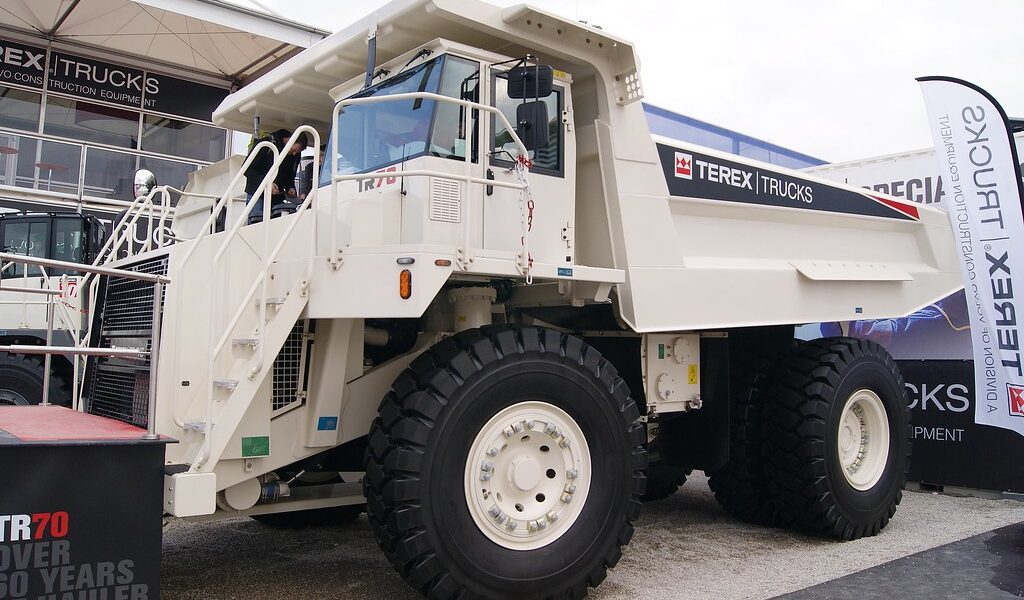
Terex Corporation operates one of the most complex brand structures in the lifting and earthmoving equipment industry. Machines sold under the Terex name share parts infrastructure with equipment bearing the Demag, Genie, and PowerScreen badges — but from a rubber component perspective, each product line has its own engineering specification. This guide covers rubber parts sourcing and maintenance for the Terex TC excavator series, TW wheel excavators, RT rough terrain cranes (RT 60, RT 100, RT 130), and AC all-terrain cranes, with a brief note on Genie telehandler components.
The Terex Brand Structure: What It Means for Parts Sourcing
Terex Corporation has historically grown through acquisition, assembling a portfolio that includes multiple product categories and brands. Key brands relevant to rubber parts sourcing:
Terex Cranes: Encompasses rough terrain cranes (RT series), all-terrain cranes (AC series), tower cranes, and truck-mounted cranes. The crane business includes the Demag brand for large lattice boom and industrial cranes.
Terex Earthmoving: The TC excavator series and TW wheel excavator series fall under this category, though Terex’s excavator line is less extensive than crane production.
Genie: Access equipment — boom lifts, scissor lifts, telehandlers. Genie remains a distinct operational brand within Terex.
PowerScreen: Crushing and screening equipment. Less relevant to standard rubber mount sourcing but uses similar anti-vibration and isolation mounts to larger construction equipment.
The practical consequence for maintenance engineers: a single contractor operating a Terex RT 100 crane, a TC 260 excavator, and a Genie telehandler cannot assume that any rubber component is interchangeable between these machines. Each requires specific identification by model, serial number, and in the case of cranes, position on the machine (carrier engine vs. superstructure components).
Terex RT Series Cranes: Rubber Isolation in Demanding Configurations
Terex rough terrain cranes — the RT 60 (60 US ton capacity), RT 100 (100 US ton), and RT 130 (130 US ton) — are the most technically demanding applications for rubber isolation components in the Terex portfolio. Crane rubber components serve functions that differ significantly from excavator or milling machine applications.
Engine Mounts: Carrier and Superstructure
Terex RT cranes have two distinct power systems. The carrier (lower) uses a main drive engine for travel, and on many RT crane configurations, the crane functions (hoist, swing, outrigger) are powered from a separate engine in the superstructure. Some RT crane configurations use a single engine with power take-off for crane functions.
Engine selection across the RT series uses multiple supplier sources:
- RT 60: Typically Cummins QSB 6.7 or Deutz TCD 6.1 depending on market and production year
- RT 100: Cummins QSL 9 or Mercedes-Benz OM 936 in different configurations
- RT 130: Cummins QSM 11 in most configurations
Each engine has its own OEM-specified mounting system. The mount specifications are not Terex-proprietary — they follow the engine manufacturer’s standard isolation requirements for that engine series. This is actually advantageous for parts sourcing: engine mount specifications for the Cummins QSB 6.7, for example, are consistent across all machine makes using that engine, not just Terex.
The key identification step: Identify the engine model from the engine data plate before ordering any engine mounts for a Terex RT crane. The crane model designation alone is not sufficient — two RT 100 machines from different production years or markets may have different engines.
Slewing Ring Isolation Pads
The slewing ring on an RT crane is the large-diameter gear and bearing assembly that allows the superstructure to rotate relative to the carrier. Rubber isolation pads are fitted between the slewing ring mounting flange and the structural members of both the carrier and the superstructure.
These pads serve a critical function: they prevent the transmission of impact and vibration from travel loading into the precision-machined slewing ring bearing surfaces. During crane travel on rough terrain — which RT cranes do regularly, often with boom elevated and hook loaded — the carrier frame deflects dynamically. Without isolation pads, this deflection transmits directly into the slewing ring, causing fretting wear on the ring gear teeth and accelerated bearing deterioration.
Slewing ring isolation pad condition should be inspected at every 500-hour interval or at every annual inspection — whichever occurs first. Look for:
- Extrusion of rubber beyond the pad’s designed footprint
- Surface cracking or hardening (indicating ozone degradation or thermal aging)
- Uneven compression across the pad surface (indicating frame distortion or improper installation torque)
Replacement pads must match the original pad dimensions precisely. Undersize pads leave gaps that allow metal-to-metal contact under load; oversize pads prevent correct mounting flange seating. Measure existing pads including their compressed thickness under load when possible, not just free-state dimensions.
Mini-Story: RT 100 Slewing Ring Pad Failure on a Wind Farm Project
A crane contractor operating three Terex RT 100 cranes on a wind turbine erection project in Ireland identified unusual slewing ring noise on one machine approximately 14 months into the project. The machine had accumulated around 1,800 hours since last inspection.
Inspection found that two of the six slewing ring isolation pads had extruded significantly beyond their designed footprint — the material had flowed under the sustained load of repeated travel with boom elevated. The extruded rubber was being cut by the gap between the slewing ring and adjacent structure on each travel cycle, generating rubber debris that had contaminated the slewing ring grease.
The slewing ring required a full clean and re-grease, and all six isolation pads were replaced. The fretting damage to the ring gear teeth was assessed as superficial and within acceptable limits. Had the issue gone undetected for another 500 hours, the contractor’s service engineer estimated the slewing ring would have required replacement — a cost roughly 15 times that of the pad set and service labour.
The contractor moved to 500-hour slewing ring pad inspections on all three machines for the remainder of the project.
Counterweight Buffer Elements
Large RT and AC cranes use removable counterweight sections that are stacked or attached to the superstructure. The contact interfaces between counterweight sections and the superstructure car body use rubber buffer elements to prevent metal-to-metal impact.
These buffers are loaded primarily in compression when counterweight sections are stacked, and in shear/tension during crane travel when the counterweight is secured but the machine experiences dynamic loading. Their primary failure mode is compression set — the buffers take a permanent set and no longer fill the design gap between components.
When buffer elements are compressed beyond their design height, metal-to-metal contact occurs during travel, transmitting shock loading directly into the superstructure. This accelerates fatigue of the superstructure welded connections and creates noise that is often mistakenly attributed to other components.
Inspect counterweight buffers at each major configuration change (full counterweight removal and reinstallation). Replace any buffer that has compressed more than 10% below its nominal free-state height.
Outrigger Pad Rubber Mounts and Isolators
Terex RT and AC cranes deploy outriggers for stationary crane operations. The outrigger beam extension joints and pad connections use rubber isolators and bump stops to manage dynamic loads during deployment and retraction, and to absorb ground reaction forces during lifting operations.
The outrigger float pads — the large plates that rest on the ground — are rubber-faced on many configurations. These are wear items that require inspection after each deployment on rough or abrasive ground surfaces. A damaged or significantly worn outrigger float pad creates uneven ground contact, reducing the effective bearing area and compromising ground pressure calculations.
For the RT 130, outrigger extension positions are computer-managed and monitored by the crane’s load management system (LMS). The LMS uses outrigger position data to determine allowable lifting radius — damage to outrigger isolation components can affect the position sensor inputs, with implications for load chart compliance.
View outrigger isolation pads and buffer elements for Terex RT and AC cranes.
Terex AC All-Terrain Cranes: Carrier-to-Superstructure Interface
The Terex AC all-terrain crane range uses a distinct carrier-to-superstructure interface from the RT cranes. AC cranes are highway-mobile machines, designed for road travel at speed, which means the carrier-superstructure connection must manage the dynamic loads of high-speed travel as well as the static and dynamic loads of crane operations.
The rubber isolation elements in the AC crane carrier-superstructure interface are designed to:
- Absorb vertical shock from road irregularities during travel (at speeds up to 75–80 km/h on good roads)
- Prevent transmission of superstructure vibration into the carrier frame during crane operations
- Provide defined compliance that allows the superstructure to settle correctly on the carrier during crane work without creating rigid connections that would over-constrain the structure
These are engineered components with specific load ratings and deflection characteristics — they are not generic anti-vibration mounts. Replacement must use components matching the original design specification. Any deviation in stiffness will alter the dynamic behaviour of the machine during travel and potentially affect the LMS calculations for on-carrier crane operations.
Mini-Story: AC Crane Interface Mount Specification Error
A crane rental company in the Middle East operating a Terex AC 100 fitted incorrect carrier-superstructure interface mounts sourced from a local supplier — the mounts were dimensionally similar but were of a softer compound than specified (45 Shore A instead of the required 60 Shore A).
During a highway transfer at 65 km/h, operators noticed unusual superstructure movement and road-holding behaviour that prompted them to reduce speed and contact their workshop. Inspection identified the mount specification error. The mounts were replaced with correctly specified units before further travel.
The incident highlighted the importance of Shore hardness certification from rubber parts suppliers. Dimensional conformance alone is not sufficient for safety-critical isolation components on highway-mobile cranes.
Request a technical consultation on crane rubber component specifications.
Terex TC and TW Excavators: Excavator Rubber Basics
The Terex TC series crawler excavators and TW series wheel excavators use conventional engine mount and cab isolation systems comparable to other European-market mid-range excavators.
Engine configuration variability: Terex excavators use Deutz, Cummins, and Mercedes-Benz engines across the TC and TW range, with selection varying by market, emissions tier, and production year. The TC 260 (26-tonne class) has been fitted with both Cummins QSB 6.7 and Deutz TCD 6.1 depending on configuration. As with the RT cranes, confirm the engine model before ordering mounts.
TC series cab mounts: Standard 4-point cab isolation using cylindrical sandwich mounts. Replacement intervals follow general construction excavator guidelines — 3,000–4,000 hours in standard applications, 2,000–2,500 hours in demolition or quarry use.
TW wheel excavator engine mounts: Wheel excavators operate on public roads and jobsites, creating a more complex vibration environment than crawler machines. Road travel creates continuous low-amplitude vibration input through the axles and frame; working creates high-amplitude intermittent shock. TW engine mounts should be inspected at 2,000-hour intervals.
Babacan Group supplies rubber isolation components for Terex TC and TW excavators to fleet operators and distributors across multiple markets, with full dimensional and hardness specification documentation.
Genie Telehandler Rubber Components: Brief Overview
Genie telehandlers — including the GTH series — use engine mounts (typically for Deutz or Perkins engines depending on model), boom pivot isolation bushings, and outrigger mounts. These components are smaller and lower in load rating than crane components but require the same attention to dimensional accuracy and compound specification.
Boom pivot bushings on telehandlers are particularly prone to wear in applications involving frequent maximum-radius lifts, which apply lateral load to the boom pivot. Inspect every 1,000 hours and replace at first sign of visible wear or play development in the pivot.
Request a quotation for Genie telehandler or Terex excavator rubber parts.
Parts Sourcing Strategy for Mixed Terex Fleets
The complexity of Terex’s multi-brand, multi-engine supplier structure creates a real challenge for fleet operators trying to maintain efficient parts inventories. Practical recommendations:
1. Build a machine-specific specification register. For each machine in the fleet, record: machine model, serial number, engine model, engine serial number, and a list of rubber component specifications with part dimensions and Shore hardness values. Do this once; maintain it as you service each machine.
2. Do not rely on model designation for ordering. Two machines with the same Terex model designation may have different engines and therefore different mount specifications. Serial number and engine data plate are the definitive references.
3. For crane rubber components, treat safety-critical items differently. Slewing ring pads, carrier-superstructure interface mounts, and counterweight buffer elements on cranes should only be sourced from suppliers who can provide Shore hardness certification and load testing documentation. Dimensional conformance is a minimum requirement, not a sufficient one.
4. Maintain forward stock of the highest-frequency items. Engine mounts for whichever engine variant is most common in your fleet, cab mount sets for excavators, and slewing ring pad sets for cranes are the items most likely to affect machine availability.
Key Takeaways
- Terex’s multi-brand and multi-engine supplier structure means the machine model designation alone is never sufficient for rubber parts identification — always confirm engine model from the data plate and machine serial number before ordering.
- Slewing ring isolation pads on Terex RT and AC cranes require 500-hour inspection intervals; degraded pads allow deflection-induced fretting on ring gear teeth, and late-stage pad failure contaminating slewing ring grease can require full slewing ring replacement.
- Carrier-to-superstructure interface mounts on Terex AC all-terrain cranes are safety-critical components with specific Shore hardness requirements — dimensionally correct but incorrectly compounded mounts alter highway travel dynamics and potentially affect load management system calculations.
- Counterweight buffer elements should be inspected at each major configuration change; compression set beyond 10% of nominal free height allows metal-to-metal contact during travel, accelerating superstructure fatigue at welded connections.
- For mixed Terex fleets (cranes, excavators, Genie access equipment), build a machine-by-machine specification register capturing engine model, serial number, and rubber component specifications — this register eliminates specification errors and enables forward stocking of the correct items.
Word Count: ~1,780 words